
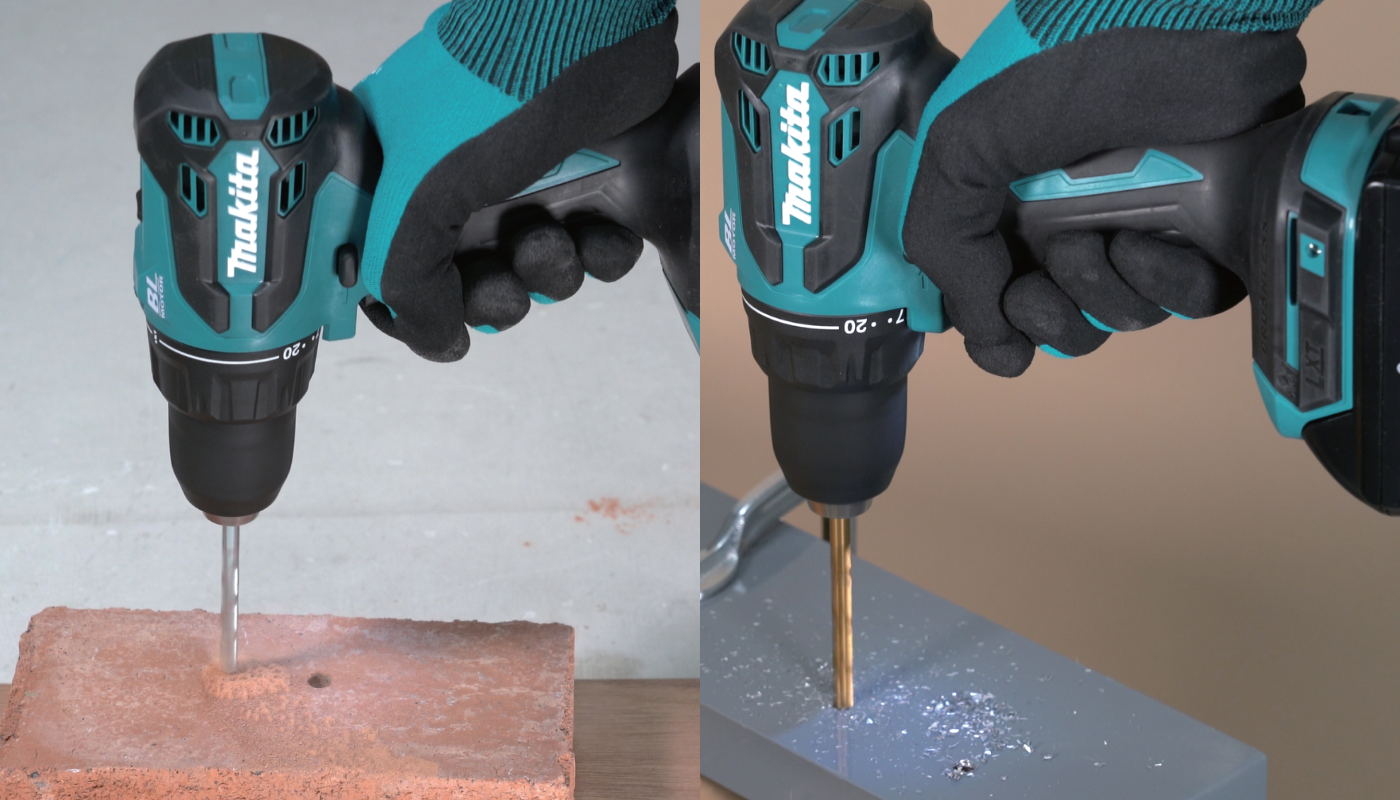
If you’ve just collected the keys to a new BTO flat, you’re probably staring at those grey walls wondering whether your trusty Makita DHP490 is up to the job. Before you burn through a pack of masonry bits, here’s the lobang on what this tool can and can’t do.
The short answer: it’s a struggle.
The DHP490 is a hammer driver drill, which is not the same thing as a rotary hammer. In high-strength Singapore BTO concrete, that distinction is everything — and almost nobody explains why.
Table of Contents
Vibration vs punching: the bit nobody explains
Three tools get called “drills” and they work in completely different ways.
A driver drill simply spins. Great for screws, wood and flat-pack furniture. Against concrete, effectively useless.
A hammer drill like the DHP490 spins and vibrates. Two ridged metal plates click past each other to produce a rapid, very short percussion — thousands of tiny taps per minute. In red brick and light masonry this genuinely works.
A rotary hammer uses a piston, driven by a crank, to physically strike the back of the bit. It’s not a stronger version of the same idea. It’s a different machine that happens to look similar.
The gap isn’t small. A hammer drill delivers a fraction of a joule per blow. An SDS-Plus rotary hammer delivers one and a half to three joules. Which is why a small rotary hammer will out-drill a large hammer drill in concrete every single time. Size isn’t the variable. Mechanism is.
Why the DHP490 fails the BTO test
The never-ending hole. BTO structural walls and household shelters are poured to serious density. Drilling one with a hammer drill feels like drilling diamond — full body weight behind it, and 1cm deep after ten minutes.
Bit burnout. All that friction with no progress goes somewhere, and where it goes is your drill bit. Masonry bits overheat, lose their carbide edge and blunt almost instantly. You’ll go through several before you finish one bracket.
Tool strain. The DHP490 is a well-built brushless tool, but concrete work it wasn’t designed for shortens its life. You’ll spend more replacing bits and stressing a good drill than a compact rotary hammer would have cost you.
When you SHOULD use the DHP490
Don’t write it off. The DHP490RFX1 kit — 65 N·m of torque, 13mm chuck, 20 torque settings, two-speed gearing and three action modes, supplied with a 3.0Ah battery and charger — is genuinely one of the best all-rounders you can own.
Use it for:
- Internal partition walls — non-structural dividers, no problem
- Cabinetry and furniture — kitchen carcasses, wardrobes, flat-pack
- Wood and metal — DIY shelving, window frames, general fixing
- Occasional single holes in light masonry
If you’re fitting out a flat, this is the tool you’ll reach for ninety percent of the time. It just isn’t the one for the other ten.
The pro tip for new homeowners
For TV brackets, kitchen cabinets, aircon brackets or anything going into a structural wall, you want SDS-Plus.
The Makita DHR183RTWJ is the one we point most homeowners at. It’s an 18V LXT cordless rotary hammer with AVT anti-vibration — meaningfully less punishing on your wrists — and a brushless motor for longer runtime. It ships with two 5.0Ah batteries, a rapid charger, a Makpac case and, critically, the DX16 dust collector.
That last part matters more than people expect. Drilling concrete indoors produces a remarkable amount of fine silica dust, and if you’re living in the flat while you work, or your renovation is already done, on-tool dust extraction is the difference between a tidy job and a week of cleaning. It’s also simply better for your lungs.
It turns a fifteen-minute struggle into about five seconds.
Bits and anchors matter more than the drill
The best rotary hammer in Singapore will still fail with the wrong consumables.
- Use SDS-Plus bits. Not optional — the shank is what transmits the hammering action. A round-shank masonry bit in a chuck adapter defeats the entire mechanism.
- Match the bit to the anchor, not the screw. A 6mm plug needs a 6mm hole, drilled to full depth plus a few millimetres for dust.
- Clear the hole. Blow or vacuum it out before inserting the anchor. Dust left in the hole is the single most common reason a fixing pulls out six months later.
- Stop pushing. With a rotary hammer, leaning on it slows you down. Let the piston work.
Three things to check before you drill
Look for conduits. Electrical conduits and water pipes run inside HDB walls, often vertically above and below switches and sockets. Drilling blind above a power point is how people find them. A basic detector costs very little next to an electrician callout.
Know which walls you can touch. Some walls in HDB flats are structural, and there are restrictions covering structural walls, ceilings and certain slabs. These vary by flat type and age. Check with HDB or your town council before drilling anything structural or overhead — the penalties are not trivial.
Mind the hours. Noisy renovation work is restricted to specific hours in Singapore, and drilling concrete is emphatically noisy. Confirm the current permitted hours before you start, and your neighbours will hate you slightly less.
The verdict
Keep the DHP490 for general handyman work — it’s excellent at it. Get a rotary hammer for the heavy walls. Trying to make one tool do both jobs is how people end up with blunt bits, a hot drill and a hole that’s still 1cm deep.
Not sure which one you need? Come and hold them.
Both tools are on the floor at our Experience Center at 645 Geylang Road. Pick them up, feel the weight difference, and talk it through with someone who actually uses them. Open Monday to Saturday, 9am–5pm.
645 Geylang Road, Singapore 389575 · +65 6546 7446
Or WhatsApp us with what you’re trying to mount and we’ll tell you which tool it needs — including telling you when the drill you already own is fine.