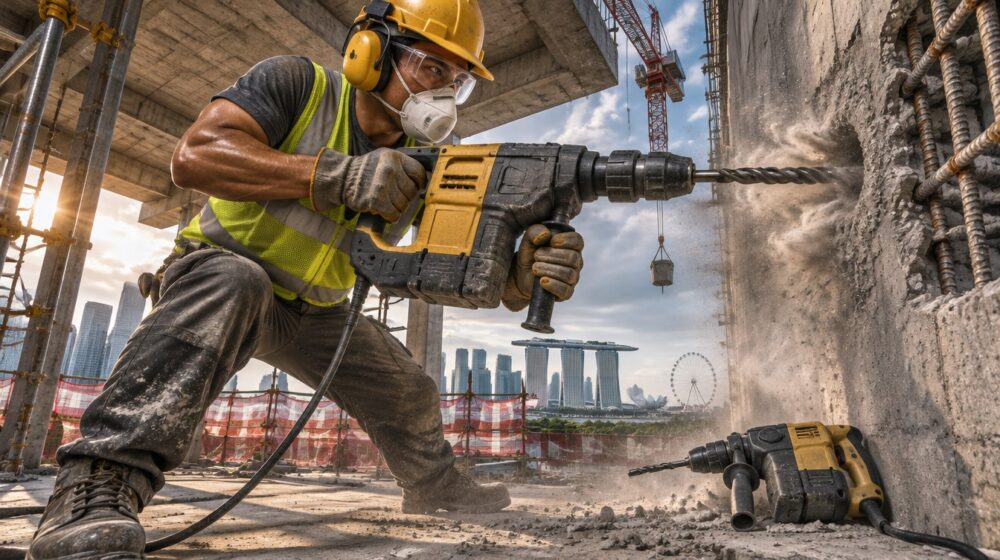
Singapore is built on reinforced concrete. Whether you are fixing anchors in an HDB ceiling, running conduit through a slab or breaking out a wall, the rotary hammer you choose decides how fast and how comfortably the job gets done. The first decision is simple but important: SDS-plus or SDS-max?
What does SDS mean?
SDS is a bit-holding system developed by Bosch in 1975 for hammer drilling. Instead of a tightening chuck, the bit has grooves in its shank and simply clicks into the tool. It slides back and forth slightly as the hammer strikes, which transfers impact energy efficiently and makes bit changes quick. Today almost every brand uses it.
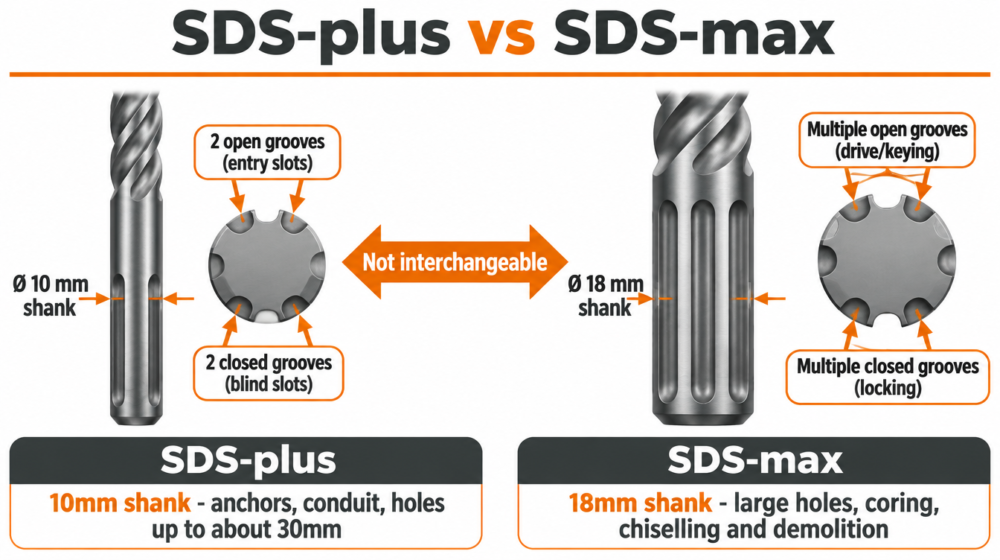
The key difference: shank size
| SDS-plus | SDS-max | |
|---|---|---|
| Shank diameter | 10mm | 18mm |
| Typical drill bit sizes | About 4mm to 30mm | Larger holes, roughly 12mm to 50mm and core bits |
| Tool weight | Usually under about 5kg | Heavier, built for sustained hard work |
| Typical jobs | Anchors, rawl plugs, conduit, plumbing and M&E fixing | Large holes, coring, heavy chiselling and demolition |
The two are not interchangeable. An SDS-max bit will not fit an SDS-plus hammer, and an SDS-plus bit will not fit an SDS-max chuck without an adaptor. Choose the system first, then the bits.
Look at impact energy (joules), not just watts
Wattage tells you how much power the motor draws; impact energy, measured in joules (J), tells you how hard each blow lands on the concrete. A compact SDS-plus hammer typically delivers around 2–3J, larger SDS-plus hammers more, and SDS-max tools from about 7J upwards, while dedicated breakers go much higher. For drilling lots of small holes, a lighter tool with lower joules is faster and less tiring. For big holes and breaking out concrete, joules matter most.
Three modes to know
- Rotation only: drilling wood or steel (usually with a keyless chuck adaptor).
- Rotary hammer: drilling concrete and masonry.
- Hammer only (chisel): chasing, chipping tiles and light demolition.
Check the model: some compact hammers are 2-mode, while combination hammers offer all three modes.
Which should you buy?
Choose SDS-plus if…
- Most holes are for anchors, plugs, brackets and conduit, typically under about 20mm.
- You work overhead, on ladders or in ceilings, where weight matters.
- You want a cordless tool to carry between units or floors.
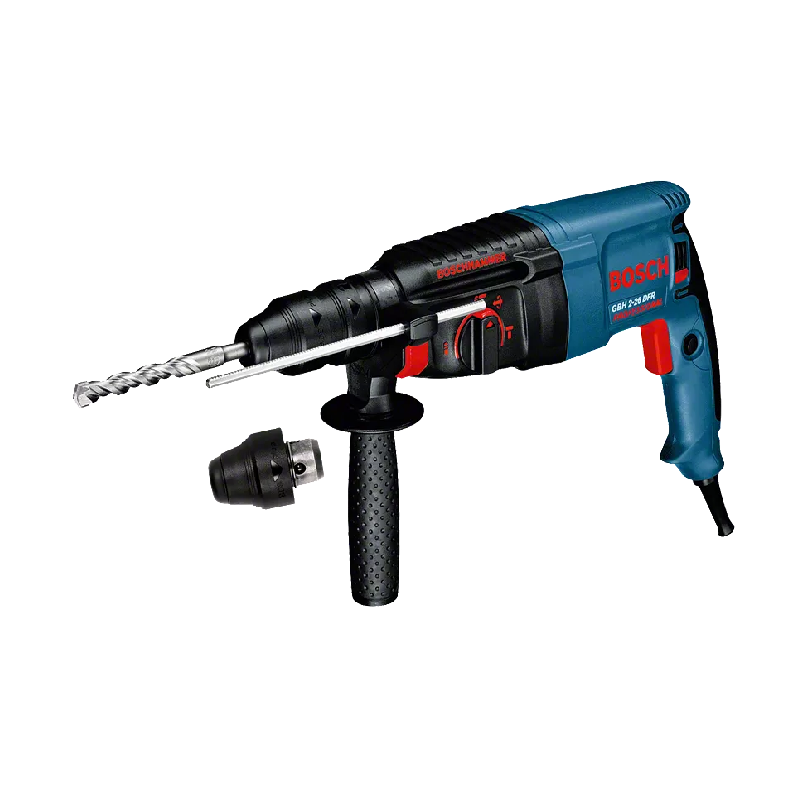
Good SDS-plus options: Makita DHR242 (18V), HR2810 and HR2670; Bosch GBH 2-26 DFR and cordless GBH 18V-26; Milwaukee’s concrete range; DeWalt’s rotary hammers; and Ingco’s RGH9528 for lighter, occasional use.
Choose SDS-max if…
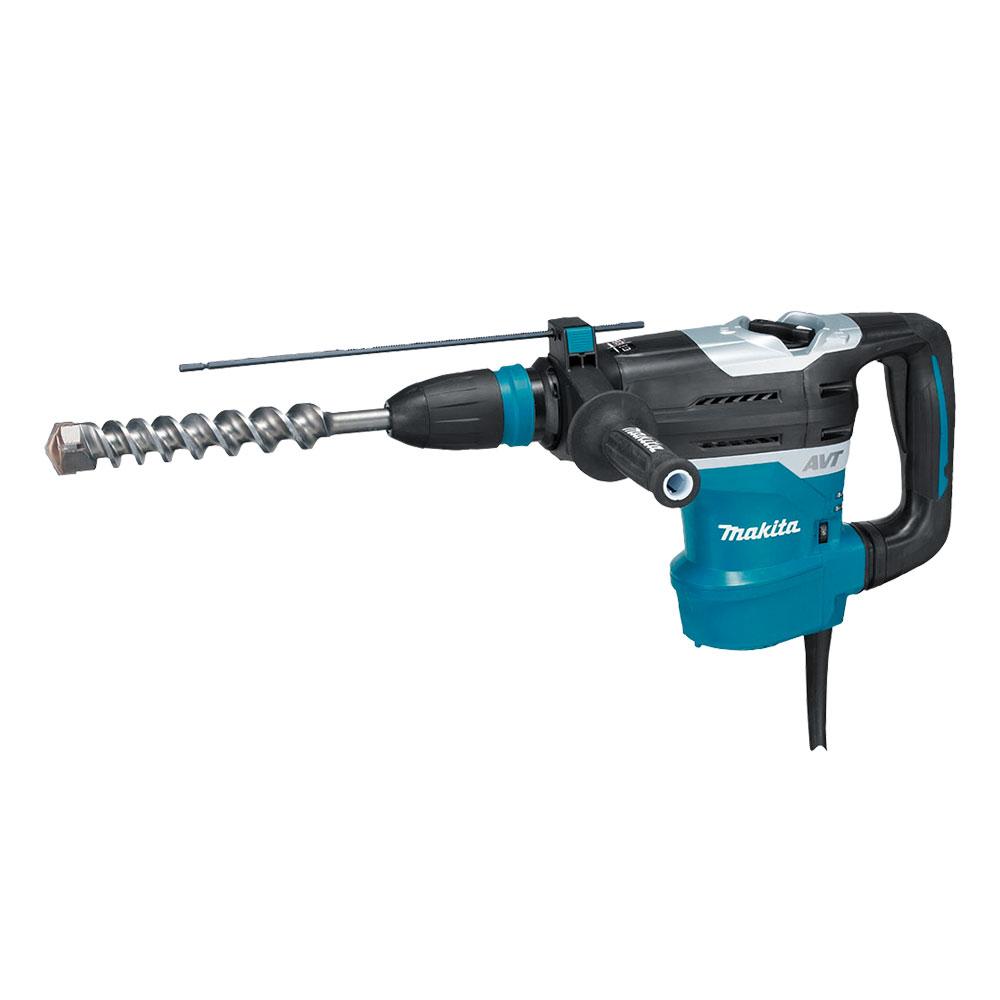
- You regularly drill holes over about 25–30mm, or core through walls and slabs.
- You chisel and break out concrete, not just tiles.
- Speed on heavy work matters more than tool weight.
Good SDS-max options: Makita HR4013C and HR5212C; Bosch GBH 5-40 D, GBH 8-45 D and cordless GBH 18V-36 C; and Ingco RH1600388.
Need to break concrete, not drill it?
Look at a dedicated demolition hammer or breaker such as the Bosch GSH 5 HX or GSH 11 VC, Makita’s demolition hammers, or Ingco’s PDB17008. Note that some breakers use a hex shank rather than SDS-max, so check the bit type before ordering chisels.
Safety and dust
Drilling and breaking concrete creates fine silica dust and a lot of noise and vibration. Use dust extraction where possible, and wear eye protection, hearing protection, gloves and a suitable dust mask. Many newer hammers include anti-vibration systems, which make a real difference over a full shift.
Not sure which one you need?
Tell us the hole sizes, the material and how many holes a day, and we will recommend a hammer and the matching bits. Browse all rotary hammers from Makita, Bosch, Milwaukee, DeWalt and Ingco.
Get a quotation: WhatsApp us or email enquiry@acthardware.com.sg.